Custom software versus off the shelf solutions
As your company scales, the basic tools and sprawling spreadsheets that successfully got you off the ground eventually begin to fracture under the immense weight of your daily operations. Data becomes siloed, manual data entry leads to expensive human errors, and your employees spend more time fighting with their rigid tools than executing actual, high-value work.
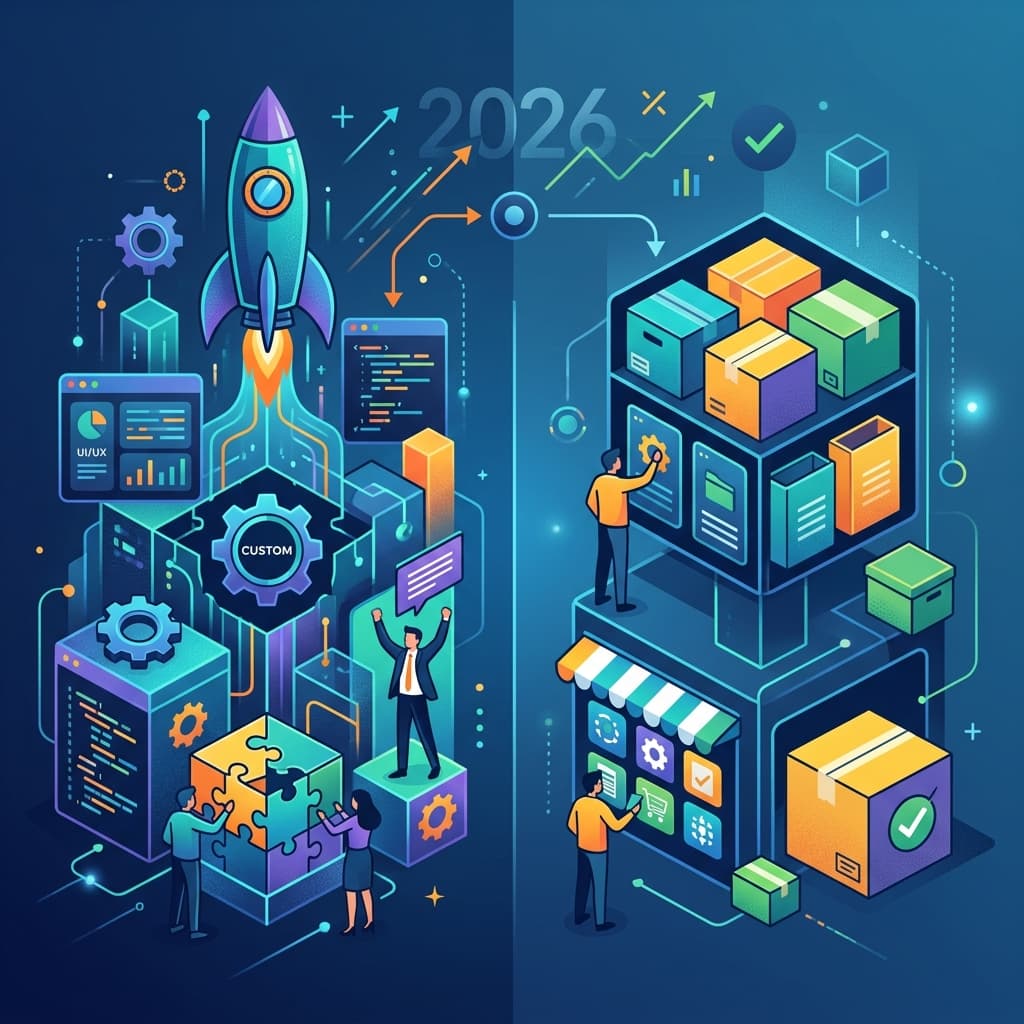
When corporate leadership finally decides it is time to aggressively upgrade the company’s digital infrastructure, they immediately face one of the most critical, expensive decisions in modern business strategy: Should we buy pre-packaged off-shelf software, or should we invest the capital to build bespoke custom software from scratch?
This is not simply an IT decision; it is a fundamental, long-term business strategy decision. The right choice will act as a massive force multiplier for your growth and profitability, while the wrong choice will trap your company in a frustrating cycle of endless subscription fees, disjointed data, and compromised workflows.
In this comprehensive guide, we will analyze the true, long-term cost of both approaches, identify exactly when each makes strategic sense, and help you determine the optimal path for your specific business software needs in 2026.
1. Understanding Off-the-Shelf Software (COTS)
Commercial Off-The-Shelf (COTS) software encompasses the massive, multi-billion dollar SaaS (Software as a Service) industry. These are pre-packaged, mass-market products heavily marketed and designed to solve common, broad problems for a massive range of different companies. Ubiquitous examples include Salesforce for CRM, Shopify for e-commerce, or QuickBooks for corporate accounting.
The Major Advantages of Going Off-the-Shelf
- Rapid, Near-Instant Deployment: Because the software is already completely built and hosted, you can theoretically sign up, swipe a corporate credit card, and have your team using it the exact same day.
- Significantly Lower Upfront Cost: You do not have to pay a highly specialized team of software engineers to architect and build the product. You simply pay a predictable, flat monthly or annual subscription fee.
- Maintenance and Hosting Included: The SaaS provider handles all server hosting, critical security patches, and rolling feature updates. You never have to worry about managing the underlying codebase or scaling the database.
The Critical Drawbacks of Off-the-Shelf
- You Must Adapt to the Software (Not Vice Versa): This is the biggest hidden operational cost. Off-the-shelf software strictly dictates how you must work. If your company has developed a highly unique, effective 5-step sales process, but the software only supports a rigid 3-step process, you must fundamentally change your company's operations to fit the software's limitations.
- Feature Bloat and UI Clutter: To appeal to millions of wildly different businesses across various industries, SaaS companies pack their products with hundreds of complex, generic features. You end up paying a premium for a massive, cluttered interface when your specific team only actually uses 10% of the functionality.
- Integration Nightmares: If you buy five different off-the-shelf tools for five different departments (HR, Sales, Ops, Finance, Marketing), getting them to securely "talk" to each other is often a logistical nightmare, resulting in fragmented data silos that blind executive leadership.
2. Understanding Custom Software
Custom software is exactly what it sounds like: a highly specialized digital solution engineered from the ground up specifically for your exact company, typically by an software development agency like Vonixsoft.
The Major Advantages of Going Custom
- The Perfect Operational Fit: Custom software is meticulously molded entirely around your existing, proven workflows. You do not have to change how your business operates; the software is engineered specifically to accelerate what you already do best.
- Absolute Ownership and Total Control: You own the Intellectual Property (IP) and the underlying codebase. You control the data entirely, which is a massive, often mandatory advantage for security and regulatory compliance (such as HIPAA in healthcare, GDPR, or SOC2 in finance).
- Infinite Scalability (No Per-Seat Fees): Off-the-shelf software almost always charges a "per-user" licensing fee. If you grow from 50 employees to 500, your SaaS bill increases tenfold overnight. With custom software, adding a new employee costs nothing in software licensing fees.
- A Unique, Defensible Competitive Advantage: If you use the exact same generic off-the-shelf software as your primary competitors, you fundamentally cannot out-operate them. Custom software allows you to build proprietary features, automations, and AI integrations that your competitors simply cannot replicate, giving you a massive operational edge in the market.
The Critical Drawbacks of Custom Software
- High Initial Capital Expenditure (CAPEX): Building robust custom software requires a significant upfront financial investment. You are paying for software architects, UI/UX designers, and senior engineers to build a complex, secure system.
- Time to Market: Unlike SaaS, which is instant, custom software takes real time to architect, code, test, and deploy securely, usually ranging from three to nine months depending heavily on the scope of the MVP.
3. The Hidden Financial Trap of Off-the-Shelf Software
When CFOs compare the two options on paper, they often only look at the immediate, day-one price tag. $2,000 a month for a SaaS product seems vastly cheaper and less risky than a $100,000 upfront investment for bespoke custom software.
However, this is a dangerous financial illusion that traps mid-market companies.
As your business grows, the "per-seat" SaaS pricing model becomes aggressively punitive. If a logistics company needs 200 drivers and 50 warehouse workers to access an off-the-shelf inventory app at $50/user/month, they are paying $12,500 every single month ($150,000 a year, forever).
Furthermore, because off-the-shelf software rarely does exactly what you need out of the box, companies inevitably end up buying "glue." They pay thousands of dollars for Zapier integrations, hire expensive consultants to build fragile API workarounds, and waste hundreds of payroll hours manually moving data between incompatible systems.
When you rigorously factor in the constantly escalating per-user fees, the hidden cost of operational inefficiency, and the lack of underlying asset ownership, the Total Cost of Ownership (TCO) for off-the-shelf software over a 3-to-5-year period is often massively higher than simply building it custom on day one.
4. When to Choose Off-the-Shelf Software
Despite the long-term drawbacks, off-the-shelf business software is the right strategic choice in specific scenarios. You should aggressively choose SaaS when:
- The Operational Process is Highly Standardized: You should almost never build custom software for standard corporate accounting (just use QuickBooks or Xero) or standard email/document processing (just use Google Workspace or Microsoft 365). These processes are universal across the globe; there is zero competitive advantage to building them from scratch.
- Capital Budget is the Absolute Constraint: If you are a very early-stage startup with extremely limited funding and you simply need a functional CRM today to survive, an off-the-shelf solution is the only viable, responsible path.
- The Software is Non-Core to the Business: If the software does not directly interact with your product delivery, your unique customer experience, or your primary revenue generation (e.g., an internal tool for booking vacation time), an off-the-shelf tool is perfectly fine.
5. When Custom Software is the ONLY Option
Conversely, there are critical inflection points where relying on off-the-shelf software will actively choke your company's growth. You must invest in custom software when:
- Your Process is Your "Secret Sauce": If your company has developed a highly unique, hyper-efficient way of manufacturing a product, dispatching global fleets, or analyzing financial data, you cannot force that proprietary process into a generic SaaS box. Custom software protects, digitizes, and scales your unique operational advantage.
- You Are Scaling Headcount Rapidly: If your headcount is growing quickly, the escalating per-user fees of off-the-shelf software will silently devour your profit margins. A one-time investment in custom software turns a growing monthly liability into a fixed, owned asset.
- You Need Complex, Unifying Integrations: If your team is currently toggling between five different, disconnected SaaS apps just to complete one single customer order, you need a custom, unified dashboard that acts as the "central nervous system" for your business, pulling data securely from all legacy systems into one clean, fast interface.
- You Have Strict Data, Privacy, and Security Requirements: If you handle highly sensitive proprietary corporate data, patient health records, or classified government information, trusting a third-party, multi-tenant SaaS provider is often an unacceptable, massive risk. Custom software allows you to architect military-grade security on your own private, single-tenant servers or on-premise hardware.
6. The Vonixsoft Approach: Building Assets, Not Expenses
At Vonixsoft.com, we have guided countless enterprises through this exact, high-stakes decision matrix. We do not believe in building custom software just for the sake of writing cool code; we only build custom software when there is a clear, undeniable mathematical case for massive ROI.
As a Experienced software development agency, our engagement process begins with a deep, rigorous operational audit of your business. If an off-the-shelf solution exists that perfectly meets 95% of your needs at a fraction of the cost, we will honestly tell you to buy it.
However, when off-the-shelf software is demonstrably holding your business back, we step in to architect the future.
- We build ruthlessly efficient tools that perfectly mirror your unique workflows, Significantly reducing employee onboarding time and eliminating manual data entry errors.
- We completely eliminate per-seat licensing fees, transforming your software budget from a bleeding monthly operating expense (OPEX) into a powerful, owned capital asset (CAPEX).
- We utilize modern, highly scalable frameworks (like Next.js for web and React Native for mobile) to ensure that the custom platform we build today can easily, securely handle 100x your current volume tomorrow.
The decision between investing in custom software and subscribing to off-shelf software is rarely a choice between right and wrong; it is a choice about the current stage of your business evolution.
Off-the-shelf business software is excellent for getting off the ground, handling standardized administrative tasks, and keeping early operational costs low.
However, as a company matures, its operational needs become hyper-specific. To break through revenue plateaus, dominate competitors, and efficiently scale operations without linearly scaling headcount, investing in bespoke, custom-engineered software is no longer a luxury, it is a mandatory strategic necessity.
Unsure Which Route is Right for Your Business?
Making the wrong software choice can cost your business years of lost momentum and hundreds of thousands of dollars in wasted capital. Let the engineering experts help you decide objectively.
Book a free software architecture audit with Vonixsoft today. Our senior engineers will deeply analyze your current operational bottlenecks, thoroughly review your software budget, and provide a brutally honest, data-driven recommendation on whether you should buy off-the-shelf or build custom.
Related Articles

Unlocking growth with WhatsApp API automation use cases and ROI
If you want to communicate effectively with your customers today, you have to meet them exactly where they already spend their time. For over 2.7 bill...
SaaS development roadmap to reach $100k MRR
A complete SaaS development roadmap and guide to taking your business from a lean MVP to a profitable scaling operation hitting $100k MRR.

The hidden return on investment of good mobile app design
When founders, product managers, and executives begin budgeting for a new digital product, there is a common, often fatal, misconception: they view ba...