
WhatsApp is where most of your customers already spend their time, and Meta built an API for businesses to reach them there at scale. The WhatsApp Cloud API is the current, Meta-hosted way to do that. 2026 has brought real changes to what it costs, especially for anything support-related. Here's how it works, and what to actually budget for.
How WhatsApp Cloud API works
The WhatsApp Cloud API is part of the WhatsApp Business Platform, and Meta hosts it directly. That's the key difference from the free WhatsApp Business App, which caps broadcast lists at 256 contacts and has no automation or CRM support. It's also different from the older On-Premises API, which required a business to run its own servers. With Cloud API, Meta handles the infrastructure, and there's no broadcast cap.
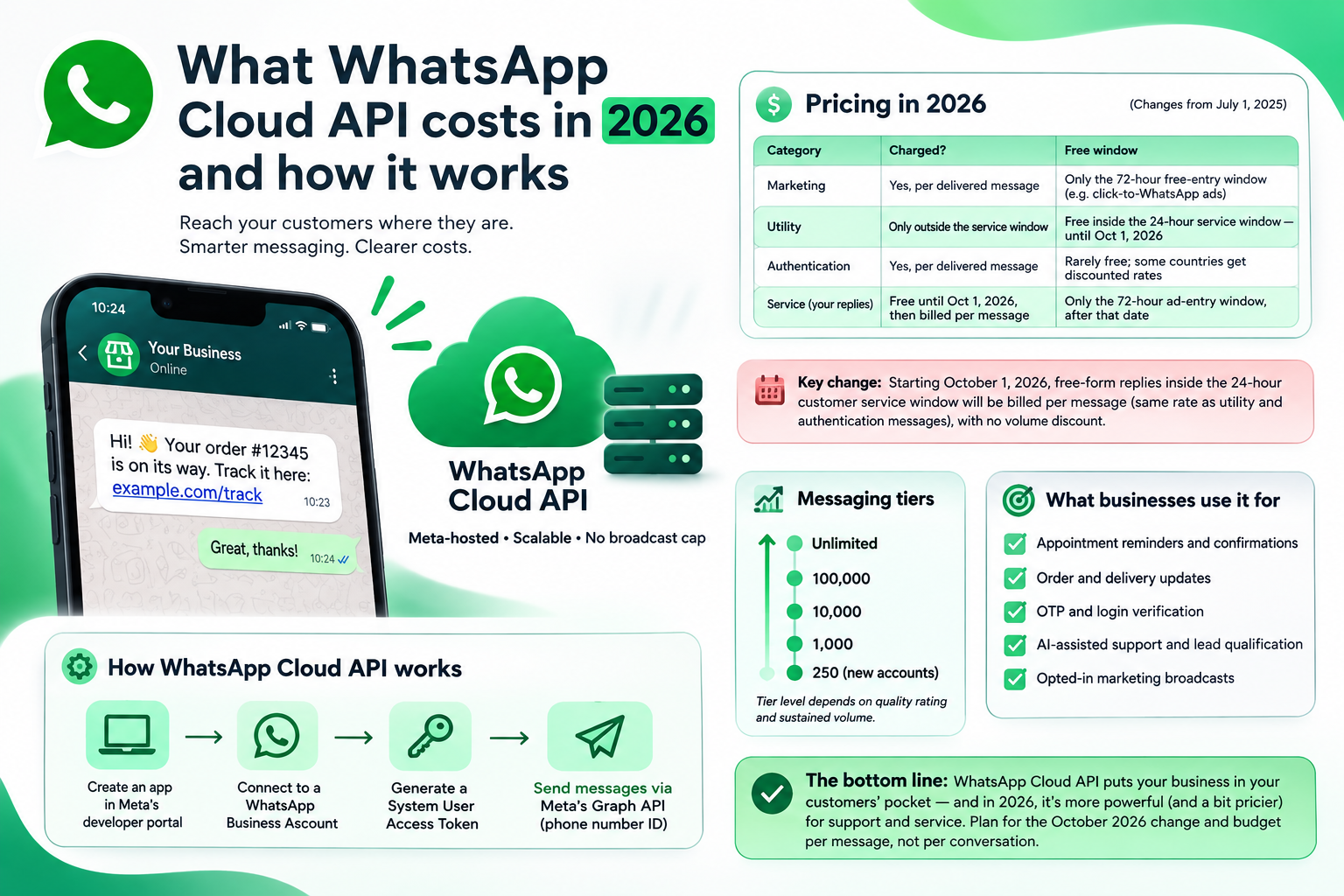
To send a message, a business creates an app in Meta's developer portal, connects it to a WhatsApp Business Account, and generates a System User Access Token. Messages go out through a request to Meta's Graph API, tied to a phone number ID.
Two pieces make it work:
- Webhooks — a URL your server exposes so Meta can push incoming messages, delivery statuses, and template updates in real time.
- Message templates — pre-written formats submitted to Meta for approval, needed any time you start a conversation outside an active service window (order updates, reminders, OTPs).
Business verification is usually the slowest part of onboarding. Once that clears, most businesses are live within days.
WhatsApp Cloud API pricing in 2026
Meta rebuilt its pricing model on July 1, 2025, moving from per-conversation to per-message billing. Every delivered template message is now its own line item, priced by category and recipient country. Here is a breakdown of the categories:
- Marketing: Charged per delivered message. Only free during the 72-hour entry window (e.g., click-to-WhatsApp ads).
- Utility: Charged only outside the service window. Free inside the 24-hour service window — until Oct 1, 2026.
- Authentication: Charged per delivered message. Rarely free; some countries get discounted rates.
- Service (your replies): Free until Oct 1, 2026, then billed per message. Only free during the 72-hour ad-entry window after that date.
The big one to plan for: Meta announced on July 1, 2026 that starting October 1, 2026, free-form replies inside the 24-hour customer service window stop being free. They'll be billed per message, at the same rate as utility and authentication messages, with no volume discount. Exact per-country rates land before September 1, 2026. This hits support teams and third-party AI bots the hardest — Meta's own built-in AI agent is exempt, but any custom or BSP-run automation isn't.
If you go through a BSP (Business Solution Provider) instead of connecting directly, expect a markup on top of Meta's base rate — commonly a fraction of a cent to a cent per message.
Messaging tiers and account setup
New accounts don't start with unlimited reach. Unverified accounts start at 250 unique contacts per day. After business verification, accounts progress through 1,000 → 10,000 → 100,000 → unlimited, based on quality rating and sustained volume.
Two things changed recently that catch people off guard:
- Since October 2025, this limit is pooled at the Business Portfolio level, not per phone number — so if you run three numbers under one portfolio, they all share the same daily cap.
- Meta now re-checks tier eligibility every 6 hours, down from the old 24–48 hour cycle, so a jump to the next tier can happen the same day.
Quality rating is driven by block rate and how people respond to your templates, so a poorly targeted broadcast can stall tier progress even when volume looks healthy.
What businesses actually use it for
The common thread across real deployments: replacing manual, one-at-a-time messaging with something that runs on its own.
- Appointment reminders and confirmations — clinics and service businesses cutting no-shows
- Order and delivery updates — e-commerce and logistics keeping customers informed without a support ticket
- OTP and login verification — authentication templates instead of SMS
- AI-assisted support and lead qualification — a bot handles first response and routine questions, then hands off to a human
- Opted-in marketing broadcasts — promotions to customers who've already engaged
The ROI case is strongest for businesses with steady volume and a workflow that's currently eating up staff time on repetitive replies. For very low volume, the free Business App may still be enough.
Direct integration or a BSP
You can connect straight to Meta's Graph API, which gives full control over cost and behavior but means your team builds and maintains webhook handling, template management, and automation logic. Or you can go through a BSP, which wraps the API in a dashboard with built-in CRM and automation for a monthly fee or per-message markup.
Direct integration tends to make sense once a business needs something a generic BSP dashboard doesn't offer — a booking flow tied into an existing system, an AI agent that actually understands the business, or messaging wired into a CRM that wasn't built with WhatsApp in mind. With the October 2026 service-message charge coming, that calculation also now includes controlling exactly how many replies your automation sends, instead of paying a flat BSP markup on every single one. That's the kind of custom build Vonix Soft does — connecting WhatsApp Cloud API into real booking systems, support workflows, and AI agents for businesses that have outgrown off-the-shelf tools.