
No AI: teacher-led brainstorming and critique
When it fits: Classroom dialogue and facilitation are the intended approach.
Trade-offs: Requires time and does not eliminate anchoring from teacher or peer examples.
Solution Study
AI can help a learner generate a promising idea, but a stronger individual output is not the same as broader diversity of thought across a class. A 2024 online short-story experiment found higher creativity ratings alongside greater similarity among AI-assisted stories; it was not a classroom study.
A 2026 undergraduate design-engineering crossover study found no general decrease in fluency, flexibility, originality or thematic diversity, while reporting lower semantic divergence in AI-assisted work. The studies examine different settings and should not be conflated.
Research-backed educational analysis and proposed learning framework. IDEATE means Initial idea, Disrupt assumptions, Explore alternatives, Assess trade-offs, Take ownership and Explain decisions. It is not a delivered Vonix Soft client case study or measured learning outcome.
A learner who accepts the first plausible generated suggestion may spend less time forming and testing an independent interpretation. Several learners exposed to similar suggestions can converge in expression even where each submission looks individually competent.
These are plausible design risks and questions, not verified outcomes in every classroom. Teachers need evidence of student reasoning rather than a polished artifact alone.
Doshi and Hauser's 2024 preregistered online experiment involved 293 short-story writers and 600 evaluators. It reported higher story creativity ratings with AI idea access while AI-enabled stories were more similar to one another. The participants were not school pupils.
Baltà-Salvador, Brasó-Vives and Peña's 2026 randomized crossover study analyzed 728 ideas, not 728 students, in undergraduate design engineering. It found no general reduction in originality or thematic diversity, but lower semantic divergence and largely passive or directive interaction patterns.
UNESCO guidance emphasizes human-centred AI competence, student judgment, responsible participation and age-appropriate, privacy-conscious educational design. It does not test the IDEATE proposal.
The reasoned design implication is to test whether a tool encourages exploration instead of passive acceptance. The proposed intervention itself remains unverified.
Teacher-led brainstorming, critique and peer review can keep ideation grounded in classroom dialogue. Open-ended chatbots can rapidly provide ideas and feedback, but their classroom constraints and safeguards remain external.
Teacher-structured use of an existing AI tool should be tested before a purpose-built product. A separate product is justified only if a clear learning or governance requirement remains unmet.
In an illustrative sustainable-courtyard assignment, a student may begin with a shaded seating sketch, examine a water-use constraint, compare a rain garden, flexible shade and a growing space, then explain a selected combination. This is not a Vonix Soft deployment or observed cohort.
The instructional goal is to help a student form, interrogate and justify ideas, not require a fixed number of AI exchanges or an automated creativity score.
When it fits: Classroom dialogue and facilitation are the intended approach.
Trade-offs: Requires time and does not eliminate anchoring from teacher or peer examples.
When it fits: A permitted tool can support a clearly bounded activity.
Trade-offs: Depends on access, privacy policy and consistent facilitation.
When it fits: A validated learning or governance gap remains after trials.
Trade-offs: Requires instructional research, accessibility work, safety review and evaluation; it is not automatically superior.
Proposed reference architecture
The proposed architecture keeps student ownership and teacher judgment outside optional AI assistance. It preserves non-AI routes and applies safety, accessibility, data-minimization and audit limits throughout.
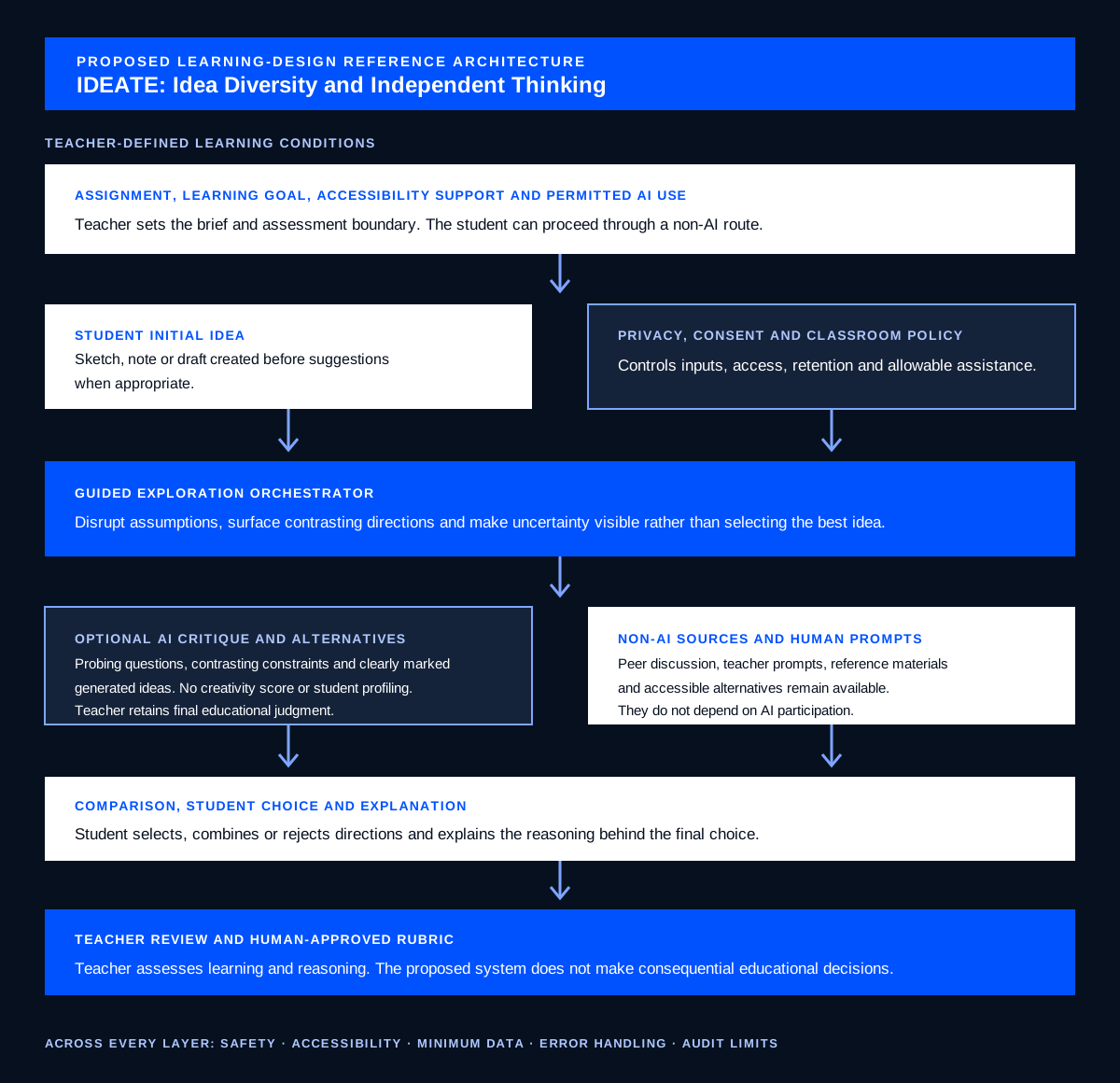
01
Defines assignment goal, accessibility support, allowed resources and permissible AI assistance.
02
Captures learner-authored sketches, notes or drafts where the activity makes this appropriate.
03
Controls access, consent, retention, allowable inputs and school-defined safeguards.
04
Uses optional AI critique and non-AI prompts to surface contrasting directions without selecting a best idea.
05
The student explains a decision and the teacher evaluates work with a human-approved rubric.
Within teacher-defined boundaries, AI can ask a probing question, surface contrasting constraints, suggest clearly marked possible directions, organize learner-authored comparisons and state uncertainty.
AI should direct the learner toward source checking or a teacher when evidence is missing. Generated ideas are starting points, not validated recommendations.
Teachers define the objective, restrictions, assessment criteria and permitted assistance. Students author, select, reject, revise and explain their ideas. Teacher assessment and consequential educational decisions remain human-controlled.
The proposed system must not produce a creativity risk score, predict student ability, grade creativity or profile learners from behavior data.
The school determines identity, access, consent, safeguarding, retention and applicable student-data requirements. Do not collect persistent student behavior profiles or raw prompts by default.
Teachers retain grading, interpretation, learning-support and other consequential educational decisions. The proposed design does not score creativity or infer student ability.
If AI output is repetitive, unsupported, unsafe, inaccessible or unavailable, show the limitation, offer a teacher or non-AI route and follow the school's policy. Learning must not depend on uninterrupted AI access.
Begin with classroom fit, policy, age group, learning objectives, non-AI alternatives and specialist review. Test low-tech teacher-led lesson designs before implementing a narrow prototype.
If justified, a prototype can focus on an initial-idea workspace, challenge prompts, option comparison, student rationale and teacher control. Evaluate reasoning, exploration, ownership, access and teacher workload before expanding.
01
Choose learning objectives, age/accessibility conditions, permitted assistance and non-AI alternatives before a pilot.
02
Compare teacher-led lesson designs using permitted materials and, where appropriate, an approved tool.
03
Implement only justified initial-idea, challenge, comparison, rationale and teacher-control features.
04
Assess reasoning, range of directions, experience, equity and teacher workload without reducing creativity to one metric.
05
Improve, adopt, integrate or abandon the hypothesis based on student, teacher and implementation evidence.
Potential failure paths include repetitive suggestions, fabricated material claims, unsafe or biased outputs, unequal access, inaccessible interactions, unnecessary student-data collection and provider outages. Each needs an explicit non-AI fallback and accountable school policy response.
Avoid persistent behavior profiles and raw-prompt collection by default. Any analytics should be minimal, purpose-limited, retention-limited and authorized under the institution's policy.
A pilot can ask whether explanations identify constraints, trade-offs and evidence; whether students considered materially different directions; whether learners can explain selections or rejections; and whether access, accommodation and teacher workload are acceptable.
Human scoring and appropriate ethical research design are essential before claiming improvement. Semantic similarity can be exploratory group-level research data, not a basis for grading or profiling an individual student.
The central trade-off is not AI creativity versus human creativity. It is whether a learning experience helps students explore possibilities, challenge a promising first answer and explain a decision.
This proposed framework has not been experimentally validated or delivered by Vonix Soft. Educational AI should be evaluated on learning behavior as well as finished-work polish.
Science Advances · July 12, 2024 · 2024 online experiment with 293 writers and 600 evaluators; supports the bounded finding on individual ratings and between-story similarity, not a classroom claim.
Thinking Skills and Creativity · March 1, 2026 · 2026 undergraduate design-engineering crossover study of 728 ideas; distinguishes originality and thematic diversity from lower semantic divergence.
UNESCO · September 5, 2024 · Human-centred student AI competence and responsible AI co-creation guidance, not evidence that the proposed framework improves outcomes.
UNESCO · September 7, 2023 · Age-appropriate, privacy-conscious and human-centred educational AI guidance, not a trial of IDEATE.

Photo by Gülfer ERGİN on Unsplash
A research-backed educational analysis of why student AI literacy should include judgment, source evaluation, external verification and human agency, not only prompt writing.
Next step