
Awareness only
When it fits: A school is starting a conversation about AI reliability and responsible use.
Trade-offs: Can establish language but may not create a repeatable verification habit.
Solution Study
Generative AI can produce a polished answer quickly, but fluency is not the same as reliability. Student AI literacy therefore needs judgment, source evaluation, external verification and human agency, not only prompt-writing skill.
This research-backed Solution Study proposes a five-step learning framework: Answer, Trace, Check, Challenge and Decide. It treats AI as an assistive starting point while keeping responsibility for belief, evidence and use with the student and the learning process.
This is research-backed educational analysis and a proposed learning framework. It is not a delivered Vonix Soft client case study, curriculum deployment or measured classroom outcome.
A clearer prompt can improve an interaction with an AI tool, but it does not prove that a student can recognize a claim, distinguish fact from interpretation, identify missing evidence, judge source quality or take responsibility for use.
The educational question is not only whether a student can make a model sound convincing. It is whether the student can decide whether the output deserves to influence their understanding.
An AI answer can be correct, partly correct, incomplete, outdated, oversimplified, unsupported or confidently wrong. Polished language can make a response look more reliable than its evidence warrants.
Students need neither blind trust nor blind distrust. They need calibrated judgment, with the level of scrutiny matched to the kind of claim and the consequences of relying on it.
UNESCO's student AI competency framework includes human agency, ethics, AI understanding, responsible use and critical judgment. It frames learning through Understand, Apply and Create, rather than reducing AI literacy to tool operation.
Stanford education experts, Digital Inquiry Group's lateral-reading work and OECD discussion of reading in the AI age each support active evaluation of claims, evidence and sources. These sources inform the proposed framework, but the framework itself is a Vonix Soft synthesis rather than an official standard.
Schools can build on digital-literacy instruction, source evaluation, lateral reading, close reading, subject-specific evidence practices and teacher-guided discussion. AI literacy does not require abandoning these foundations.
The practical opportunity is to make the verification habit explicit when students use AI-generated answers, summaries, explanations, citations or recommendations.
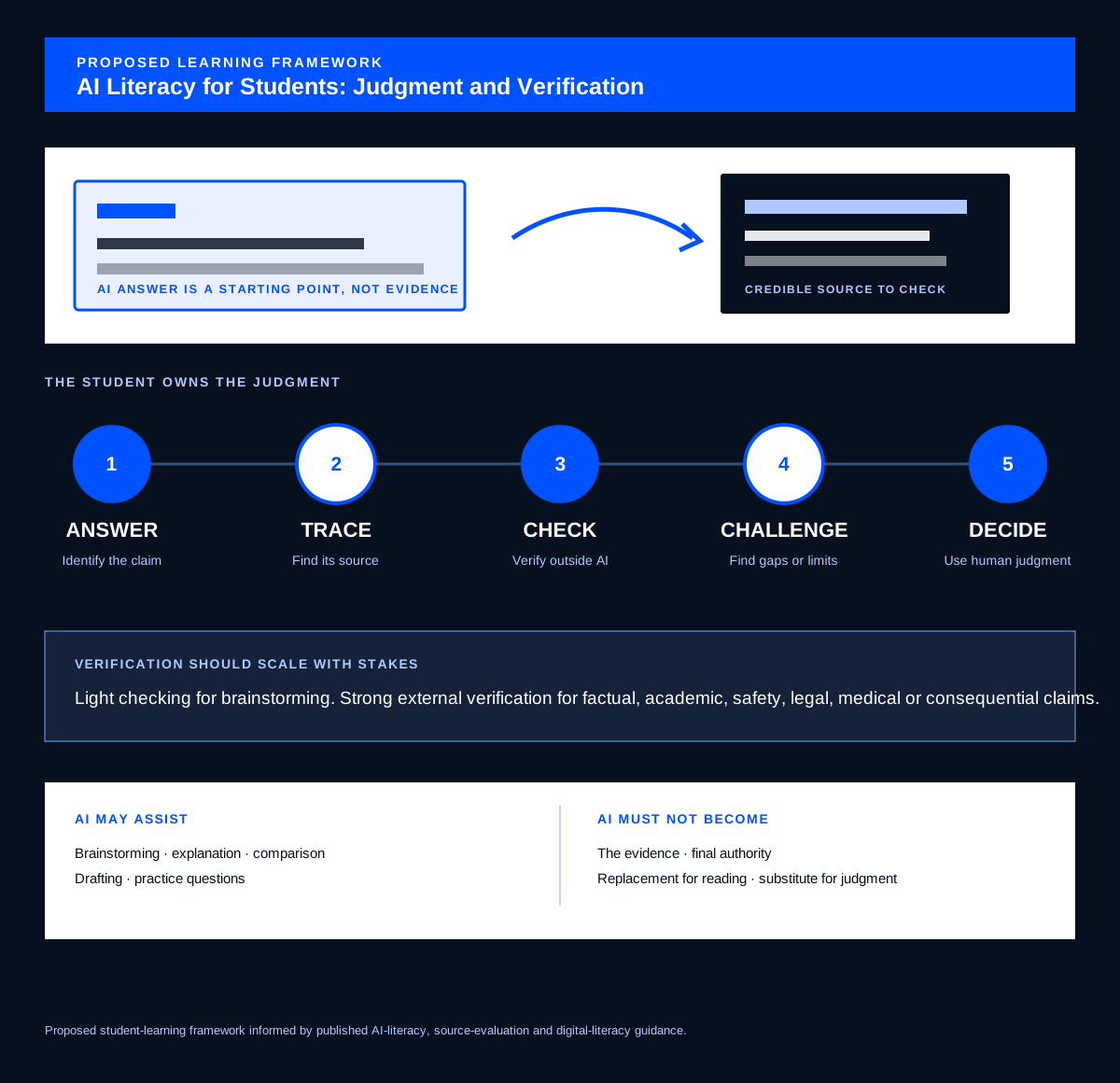
ANSWER means identifying what the model is actually claiming. TRACE means investigating where an important claim came from and whether the cited or implied source exists, is authoritative and is current enough.
CHECK means verifying meaningful claims outside the AI interface against assigned materials, primary sources, official sources or independent credible sources. CHALLENGE means looking for missing evidence, oversimplification, assumptions and plausible alternatives. DECIDE means using human judgment to accept, revise, cite, reject, investigate further or ask a teacher or expert.
When it fits: A school is starting a conversation about AI reliability and responsible use.
Trade-offs: Can establish language but may not create a repeatable verification habit.
When it fits: Teachers need a shared, simple method for discussing AI-generated answers and sources.
Trade-offs: Requires curriculum-context adaptation and teacher preparation.
When it fits: Students can practice with bounded examples in existing subjects.
Trade-offs: Needs careful source selection, age-appropriate guidance and teacher review.
When it fits: The school wants to reward verification, reasoning and revision alongside final output.
Trade-offs: Requires clear expectations and assessment design, not just an AI policy.
Proposed reference architecture
The framework makes AI output a starting point for inquiry. The student traces and checks meaningful claims, challenges gaps and uses human judgment to decide how the information should be used.
01
Identify the main claim and distinguish facts, interpretations, recommendations and acknowledged uncertainty.
02
Investigate the source of important claims, including whether it exists, is credible and is current enough.
03
Verify meaningful claims outside the AI tool using assigned materials, primary, official or independent credible sources.
04
Look for missing evidence, oversimplification, assumptions, uncertainty and alternative interpretations.
05
Use human judgment to accept, revise, cite, reject, investigate further or ask a teacher or expert.
Light checking may be appropriate for low-stakes brainstorming, practice vocabulary or note formatting. Important factual claims in a class presentation, historical explanation, scientific discussion or essay argument need external verification.
For medical, legal, safety, official academic or other consequential information, students should rely on authoritative sources and qualified adults or professionals, not AI alone. Trust should scale with stakes.
Start by explaining that AI fluency is not the same as reliability. Teach the five steps, then use short guided examples in history, science, literature or current events where students identify claims, compare sources, find uncertainty and revise a response.
Assess verification, source evaluation, reasoning and revision rather than only final polished output. Encourage students to explain what they accepted, changed or rejected and why. This is a suggested direction, not a validated deployment methodology.
01
Introduce the difference between fluent AI output and reliable evidence.
02
Teach Answer, Trace, Check, Challenge and Decide with age-appropriate examples.
03
Use short examples in existing subjects with teacher-led source evaluation and revision.
04
Assess verification, source quality, reasoning and revision in addition to final output.
05
Ask students to explain what they accepted, changed or rejected and why.
AI can help with brainstorming, explanation, idea comparison, drafting, practice questions and counterarguments. These uses can support learning when the student remains engaged with the reasoning and evidence.
A student should be able to inspect the output, test important claims outside the tool and revise or reject it. AI assistance should remain visible and contestable rather than becoming invisible authority.
AI should not become evidence by itself, the final authority on truth, a replacement for assigned reading, a substitute for student reasoning or the sole source for consequential decisions.
AI can support student thinking. It should not own student belief.
Teachers and schools define approved AI tools, age-appropriate use, assignment rules and when students should involve a teacher, qualified adult or professional. AI access does not remove the need for source and safety boundaries.
Students retain responsibility for their reasoning and teachers remain responsible for educational guidance and assessment. Qualified adults or professionals remain important for high-stakes medical, legal, safety and other consequential questions.
When a source cannot be found, evidence conflicts, an answer lacks support or a claim is consequential, the student should identify the uncertainty, avoid treating the output as established fact and seek a credible source or appropriate human guidance.
The five-step model is a proposed synthesis, not a formal UNESCO model or a claim of endorsement. Verification effort varies by context, and students can still struggle to distinguish credible from weak sources even when a source appears professional.
AI tools can cite sources differently, express uncertainty unevenly and return different answers to the same prompt. This study does not claim a deployed Vonix Soft curriculum, guaranteed learning outcome or measured efficacy result.
Education should not reduce AI literacy to prompting alone. Students need a disciplined way to identify claims, trace sources, verify meaningful information outside the tool, challenge weak reasoning and decide responsibly how to use the result.
AI can generate the answer. The student still owns the judgment.
UNESCO · Human agency, ethics, responsible use, critical judgment and AI competency context.
UNESCO · Additional framework context; not an endorsement of the proposed five-step model.
UNESCO · Human-centred and responsible-use context for AI in education.
Stanford Graduate School of Education · May 1, 2025 · Expert educational perspective on digital literacy and AI-generated misinformation.
Digital Inquiry Group · Source-evaluation and lateral-reading instructional context.
Digital Inquiry Group · Research context for verifying claims outside an initial source.
OECD · September 1, 2026 · 2026 discussion of reading, evidence evaluation and AI-generated information; not a simple causal claim about learning outcomes.

Photo by Tato Lopez on Unsplash
Higher-education AI can retrieve policies, answer questions, and assist with student-service work, but reliable operation depends on knowing which source is authoritative, what data must be read live, who may see it, and which actions require institutional approval.

Photo by Martin Woortman on Unsplash
K-12 schools can have capable SIS, LMS, attendance, assessment and family communication tools yet still face fragmented workflows as one student journey crosses platforms. This study examines how standards, APIs, identity and role mapping, workflow orchestration and controlled AI assistance can connect them without creating a second source of truth.
Next step