Vonix Soft Logo

Solution Study

What Should AI Trust in Higher Education?

A university should not treat a single AI index, chatbot or model as a new source of truth. Student services can span student information systems, learning platforms, admissions or CRM systems, finance, advising tools, policy repositories, departmental workflows and local knowledge.

The proposed Permission-Aware Student Service Intelligence Layer is a technology-neutral integration and control layer around existing systems. It separates curated institutional knowledge, live student-specific records, bounded AI assistance, deterministic rules and authorization, and human approval for consequential actions.

This is a research-backed solution study and proposed reference architecture. It is not a delivered Vonix Soft client case study or a claim about a university implementation.

Higher educationSource authorityPublished October 6, 2026By Mirza Abdul Rehman, AI Engineer
01

The problem

A question such as whether a student may still withdraw from a course and what happens to their fees can depend on current enrollment in the SIS, the authoritative policy version, term dates, student-account rules, program-specific exceptions and an official workflow. A document chatbot can retrieve a policy but cannot by itself establish current state, authority, access or approval for a transaction.

Retrieval, explanation, recommendation, approval and action are different responsibilities. Before an AI-assisted system answers, it needs to know which system owns the fact, whether the information is curated or live, which roles may access it, what happens when sources conflict and who owns an exception.

02

Why it matters

EDUCAUSE's 2025 QuickPoll on data modernization described fragmented and siloed environments, inconsistent data quality, governance challenges, constrained resources and legacy systems as barriers. Its 165 responses are rapid community-poll context, not a representative industry census or a universal institutional measurement.

EDUCAUSE's work on the student journey calls attention to cross-organizational processes and data flows. Its 2026 work on knowledge management for safer AI notes the need to validate institutional knowledge, manage incomplete or outdated materials and respect information boundaries.

1EdTech's Edu-API demonstrates that interoperability remains an active campus concern. Standards may reduce integration friction, but they do not remove institution-specific decisions about identity, authority, data sensitivity, workflow ownership, exceptions or approvals.

03

Current state and system context

In a withdrawal and fees scenario, the policy repository may own general withdrawal guidance, the SIS may own current enrollment, a finance system may own the account state and a registrar or finance workflow may own the official decision. A useful assistant should identify the applicable sources and limitations instead of presenting a fluent synthesis as an authoritative institutional action.

Root causes can include fragmented systems, fragmented ownership, incomplete or inconsistent knowledge, live data mixed with indexed knowledge, permission differences, an answer-to-action gap, and integration or operational debt. The system must make those boundaries explicit rather than hiding them behind one chat interface.

04

Existing approaches

Higher-education platforms already solve substantial parts of the problem. Student information systems, education CRM and student-service platforms, learning platforms, productivity suites and interoperability standards may already provide important workflow, identity and integration capabilities.

The starting question is not whether an institution should build a new AI platform. It is which requirements are already covered and which cross-system gaps still matter after the existing stack is configured correctly.

06

Proposed solution

The Permission-Aware Student Service Intelligence Layer sits around existing institutional systems and preserves their authority. It makes four boundaries explicit: what approved information can be retrieved, what must be read live from a system of record, what rules can determine versus what requires judgment, and which actions may be executed with which approval.

Curated knowledge and live student data use separate retrieval paths. Policies, procedures, calendars and approved FAQs can use governed curation with provenance and lifecycle controls. Current enrollment, holds, account state and workflow status require authorized live reads when freshness and transaction authority matter.

05

Options and trade-offs

Improve governance and process first

When it fits: Source ownership, documentation, definitions and workflow are the main problem.

Trade-offs: Requires institutional ownership and change management; it may not meet a justified live-data or cross-system requirement.

Configure existing SIS, LMS, CRM or AI features

When it fits: The current suite already covers the required workflow.

Trade-offs: Cross-vendor gaps, licensing, local systems and custom policies may remain.

Buy a student-service platform

When it fits: A product meets the required service workflow.

Trade-offs: Adds another platform and integration dependency that needs validation.

Integrate and extend the installed stack

When it fits: Core systems remain, but the experience crosses them.

Trade-offs: Requires API, identity, mapping and maintenance ownership.

Build custom orchestration

When it fits: A validated cross-system requirement cannot reasonably be met through existing capabilities.

Trade-offs: Has the highest engineering and operational burden.

Hybrid

When it fits: Existing suites cover core functions while a thin custom layer fills defined gaps.

Trade-offs: Needs clear ownership across vendor and custom boundaries.

07

Proposed reference architecture

Reference architecture

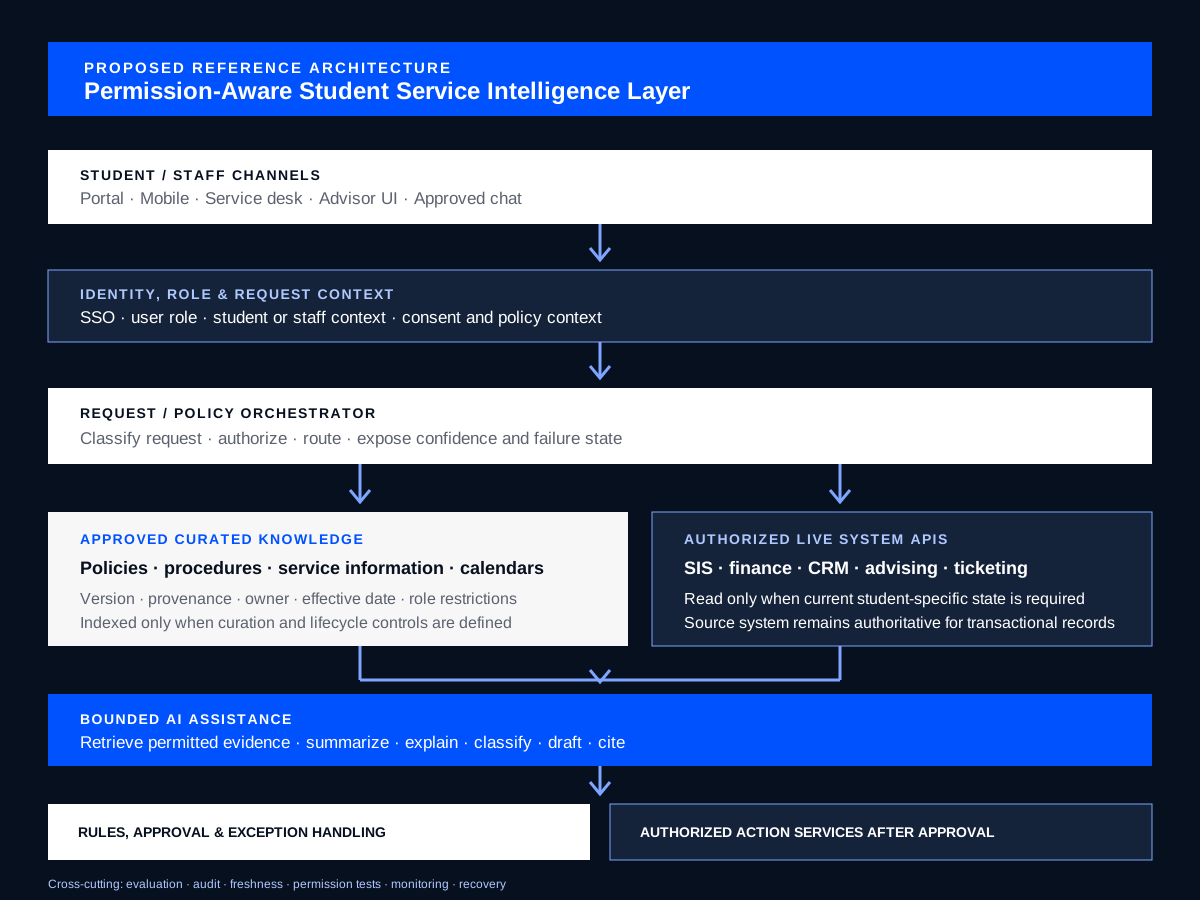
The architecture keeps curated and indexed knowledge distinct from live system-of-record data, and places rules, approval and exception handling before any consequential action service.

Proposed higher-education source-authority architecture showing trusted sources, permissions-aware retrieval, grounded AI assistance, reviewer approval and audit monitoring.

01

Student and staff channels

Portal, mobile, service desk, advisor UI and approved chat interfaces initiate the request.

02

Identity, role and request context

SSO, user role, student or staff context, consent and policy context are established before retrieval.

03

Request and policy orchestration

Classifies requests, checks authorization, routes work and exposes confidence or failure states.

04

Approved curated knowledge

Policies, procedures, service information and calendars carry provenance, version, ownership and lifecycle controls.

05

Authorized live system APIs

SIS, finance, CRM, advising and ticketing systems provide permitted current context while retaining their authority.

06

Bounded AI assistance

Retrieves permitted evidence, summarizes, explains, classifies, drafts and cites within approved task boundaries.

07

Rules, approval and exception handling

Deterministic checks, institution-controlled approval and named exception ownership sit before action.

08

Authorized action services

Controlled write APIs use explicit authorization, idempotency, audit and confirmation.

09

Cross-cutting controls

Evaluation, audit, freshness, permission tests, monitoring and recovery apply across the architecture.

07

Where AI helps

AI may find relevant approved knowledge, summarize policy and case context, answer bounded informational questions with sources, classify incoming requests, identify missing information, draft student or staff responses, prepare a case packet and recommend routing to an approved workflow.

These tasks remain bounded by application authorization, permitted evidence and source authority. The model is not an independent decision maker.

Approved knowledge retrievalPolicy and case-context summarizationBounded source-linked answersRequest classificationMissing-information detectionResponse draftingReviewer case-packet preparationWorkflow routing
08

Where AI should not decide

Deterministic application logic should own authentication, authorization, role mapping, API access control, deadline rules, required-field validation, workflow state, retries, idempotency, audit records and system-of-record write operations.

Institution-controlled high-impact decisions should remain with responsible people or formal workflows, including policy interpretation where evidence conflicts, discretionary exceptions, admissions judgment, grading or assessment judgment, disciplinary or safeguarding decisions, and consequential financial decisions.

Permissions

Authorization must be enforced by the application and source systems, not merely described in an AI prompt. The institution should define source owner, authoritative question scope, effective date, refresh method, sensitivity classification, permitted roles, escalation owner and whether a source may inform an action.

Human review

Responsible institutional people or formal workflows retain authority for conflicting evidence, discretionary exceptions, admissions, grading, disciplinary or safeguarding decisions, and consequential financial decisions as defined by institutional policy.

Exceptions

Conflicting sources should be shown as conflicts and routed for review. Missing evidence should return an unconfirmed state and next institutional route. Stale knowledge, unauthorized data, live API failure, model uncertainty and action failure require explicit freshness, escalation, retry, audit and confirmation behavior.

09

Implementation approach

Phase 0 maps systems, knowledge sources, source owners, permissions, roles, current workflows, exceptions and existing vendor capabilities. Phase 1 begins with a staff-facing, read-only curated domain where people can validate answers and sources. Phase 2 adds one or two authorized live reads with source and freshness context.

Later phases add workflow and exception routing, then only narrow approved actions with deterministic preconditions, explicit authorization or approval, audit and failure handling. Expansion follows measurable, owned initial workflows and continuous evaluation, permission testing, source lifecycle management and operational monitoring.

  1. 01

    Phase 0: discovery and source authority

    Inventory systems, source owners, roles, permissions, current workflows, exception paths and existing capabilities.

  2. 02

    Phase 1: staff-facing read-only knowledge

    Use a small curated domain where staff validate answers, sources, missing context and content gaps.

  3. 03

    Phase 2: live read-only student context

    Connect one or two authoritative APIs and display role context, source and freshness.

  4. 04

    Phase 3: workflow and exception routing

    Add request classification, missing-information checks, case preparation, human review, status and ownership.

  5. 05

    Phase 4: selected approved actions

    Add only narrow, tested actions with deterministic preconditions, explicit authorization or approval, audit and failure handling.

  6. 06

    Phase 5: expansion and operations

    Expand after workflows are measurable and owned, while continuing evaluation, permission testing, lifecycle management and monitoring.

10

Risks and limitations

Architecture, vendor capabilities, licenses, APIs, specifications and institutional policies are context-specific and can change. Knowledge curation requires ownership, integration does not fix poor policy or process design, and a custom layer creates maintenance and operating responsibility.

This study does not establish legal or regulatory compliance, certify a design, claim a delivered university deployment, or claim ROI, retention, grade, revenue, productivity or student-outcome improvement. Each institution must define its actual policies, decision rights and applicable requirements.

11

Decision checklist

Which existing SIS, LMS, CRM, service or AI capabilities already solve the use case? Which requirement remains measurable and important? What information must be live versus indexed? Which roles may see each data class? Which actions require human approval? Who owns the custom layer, vendor changes, continuous correctness testing and access-control testing?

12

Conclusion

The important higher-education AI question is not simply whether a model can answer a student's question. It is whether the institution has defined what AI is allowed to know, which source has authority, when live data is required, what each role may see, what happens when evidence conflicts and who owns the next consequential action. Source authority comes before automation.

Sources

  1. 01EDUCAUSE QuickPoll Results: Data Modernization and Management

    EDUCAUSE Review · June 9, 2025 · Bounded community-poll evidence on fragmented data, data quality, governance and modernization barriers.

  2. 022025 EDUCAUSE Top 10 #3: Smoothing the Student Journey

    EDUCAUSE Review · October 23, 2024 · Cross-organizational student-service processes, data flows and conflicting definitions.

  3. 032026 EDUCAUSE Top 10 #5: Knowledge Management for Safer AI

    EDUCAUSE Review · October 29, 2025 · Institutional knowledge validation, data restrictions and expert curation for AI.

  4. 04Edu-API

    1EdTech · Higher-education academic enterprise data interoperability context.

  5. 05Workday Student

    Workday · Vendor context that substantial existing student-system capabilities may already be available.

  6. 06Education Cloud

    Salesforce · Vendor context that substantial education CRM and student-service capabilities may already be available.

Related

Related resources

AI Solutions and AutomationsCustom Software DevelopmentCloud and DevOpsBusiness SystemsIntegration SolutionsAI and Automation Solutions

Next step

Discuss the system, ownership and decision boundary behind the problem.

Discuss your system architecture