
Improve the existing information system
When it fits: Content ownership, search quality or workflow gaps are the main issue.
Trade-offs: May not meet a justified live-data or cross-system requirement.
Solution Study
An enterprise AI assistant can help people find, compare and explain permitted information. It should not decide which business record is authoritative, grant access, or initiate a consequential action merely because a model produced a fluent answer.
This proposed reference architecture separates authenticated access, permitted evidence retrieval, bounded AI assistance, named exception review and independently authorized write-back. It is a research-backed solution study, not a delivered client case study or a report of a Vonix Soft client implementation.
One employee question can span versioned policy documents, a CRM, an ERP, work-management systems and teams with different permissions, update schedules and data owners. Search relevance does not establish access rights, data freshness or source authority.
The practical design question is not simply whether a model can retrieve information. It is how the application should behave when the requested evidence is restricted, stale, incomplete or genuinely conflicting.
Microsoft's 2023 Work Trend Index reported that 62% of surveyed respondents said they spent too much time searching for information. This vendor-authored historical survey is context for the information-retrieval problem, not evidence of a current universal enterprise metric or a Vonix Soft result.
Enterprise-platform documentation also makes clear that connectors and retrieval require configuration, identity and governance decisions. A connector does not remove responsibility for source permissions, revocation behavior, record ownership or business approval.
A single business question may require an approved document, a current system record and an owner-defined rule for resolving discrepancies. Each source can have a different owner, access model, refresh behavior and authority for a particular metric.
For example, if a CRM reports $10,000 and an ERP reports $12,000 for the same customer, metric, currency and as-of date, an assistant may compare permitted records and explain the discrepancy. It should report an unconfirmed state and route review rather than selecting a value by department label or inventing a $2,000 payment explanation.
Some organizations can improve the current information system without new generative AI by resolving content ownership, search metadata, outdated policy material and manual approval gaps. Others may evaluate a licensed enterprise suite and its supported identity, connector and workflow options first.
A custom application is justified only where a tested integration, access, evidence or approval requirement remains unmet. There is no universal winner: conventional search, configuration, extension and custom software should be compared against the same representative scenarios.
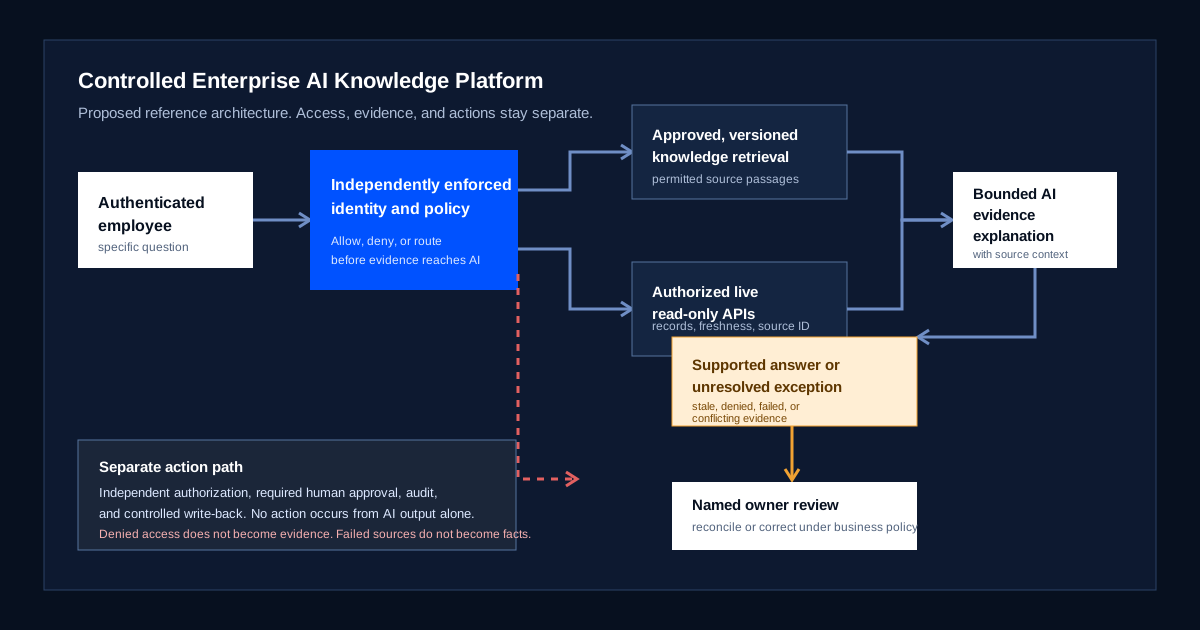
The proposed design treats AI as a bounded evidence-and-drafting component. Authenticated users enter through an approved portal or assistant. An independently enforced policy layer determines whether a request can use approved documents, an authorized live read-only source, a clarification path or a separately governed action path.
The response displays permitted source context and freshness. When material evidence conflicts or is insufficient, the response is explicitly unconfirmed and the matter is routed to a named data owner. Any write-back uses a separate application service with source-system authorization and, where required, human approval.
When it fits: Content ownership, search quality or workflow gaps are the main issue.
Trade-offs: May not meet a justified live-data or cross-system requirement.
When it fits: Supported connectors, identities and workflows satisfy representative tests.
Trade-offs: Availability, licensing, identity and source-specific controls still need verification.
When it fits: A small, demonstrated gap remains around an API, access check or approval workflow.
Trade-offs: Adds integration and maintenance responsibility.
When it fits: Material integration, workflow or procurement needs are not met by tested alternatives.
Trade-offs: Requires a full operating model for security, monitoring, support and change management.
Proposed reference architecture
Access, evidence and actions remain separate. The model only receives permitted, task-relevant evidence and cannot use an attractive answer as an authorization to write to a business system.
01
Authenticate the actual user and independently determine the permitted request path before any retrieval reaches the model.
02
Use versioned approved documents and, where required, authorized read-only live APIs with source metadata and freshness context.
03
Explain, summarize and draft only from permitted evidence, with source context visible to the user.
04
Route insufficient or conflicting evidence to a named business data owner instead of fabricating certainty.
05
Reauthorize any write-back, apply human approval rules, and own retries, audit events and source-system authorization.
AI can organize permitted evidence, summarize differences, retrieve source-linked material, draft a response and prepare a discrepancy report. These are assistance tasks bounded by the evidence and permissions already enforced outside the model.
AI should not authenticate a user, infer access rights from a prompt, decide that a record is authoritative, resolve an accounting or operational discrepancy without owner-defined rules, or commit an action to an ERP, CRM or another operational system without independent authorization.
Use enterprise identity and source authorization mechanisms. A relevance filter or instruction in a prompt does not replace authentication, document-level access checks or authorized live API access.
A named business owner resolves conflicting or insufficient evidence. A separate accountable approver authorizes consequential actions when business policy requires it.
Return an explicit unconfirmed state with permitted source context, then route the matter to the designated owner. Denied, stale, incomplete and conflicting evidence are operational states to handle, not gaps for the model to guess through.
Start with discovery and information ownership: select representative questions, map the relevant sources, identify sensitive fields, define freshness requirements and assess whether non-AI improvements already solve the need.
Then test existing suite coverage, run a controlled read-only first release, include adverse cases such as permission denial, revoked access, stale records, source disagreement and API failure, and expand only where evidence, operations ownership and approvals are defined.
01
Map representative questions, source owners, sensitive fields, permissions and freshness requirements.
02
Test conventional search, existing enterprise suite coverage and justified extensions before custom development.
03
Use one approved knowledge flow and one authorized live-data question without write-back.
04
Test denied access, revoked access, stale evidence, source disagreement, injection attempts and API outages.
05
Add scopes or human-approved actions only after the required policy, ownership and operations controls are verified.
Important risks include access oversharing, synchronization or revocation delay, stale or conflicting records, prompt injection, excessive agency, changing connector or licensing boundaries, and the operating cost of custom middleware.
This study does not claim a deployed client platform, performance benchmark, ROI, accuracy rate, certification, security guarantee or vendor partnership. Product availability, licensed entitlements, region and connector behavior must be verified in the target environment.
Which system owns the answer for this exact metric, entity and time period? Which users may see each source? How current must the information be? What should happen when evidence conflicts? Which existing suite features already meet the use case? Which actions require an accountable human approval?
A useful enterprise AI interface works within a defined information and decision structure. Document one representative cross-system question, the source owners, permission model, freshness requirement and current approval path before selecting a product or requesting custom work.
Microsoft · May 9, 2023 · Historical vendor-authored survey context for the information-search finding.
Microsoft · Connector visibility and access-configuration boundary.
AWS · Application responsibility for authenticated user context and ACL-aware retrieval.
Microsoft · Synced versus live federated read-only connector context.
Microsoft · Prerequisite and licensing boundaries to verify.
AWS · Knowledge/action integrations and user versus service authentication.
AWS · ACL synchronization and operational limitations.
Google Cloud · Custom connector, ACL and identity-mapping context.
Google Cloud · Identity and access requirements.
Microsoft · Filtering is not a replacement for authentication.
AWS · Time-sensitive product-availability correction to recheck before selection.
NIST · Voluntary risk-management guidance, not a product certification.
OWASP · Relevant application-risk taxonomy.

Photo by Lucas van Oort on Unsplash
A research-backed reference architecture for giving logistics exceptions a clear owner, evidence trail, human approval boundary and update path around the existing ERP, WMS, TMS and visibility stack.
Next step