
Fix the existing process
When it fits: The main problem is unclear responsibility, policy or manual handoff rather than missing system data.
Trade-offs: Can leave useful event, document or exception evidence fragmented.
Solution Study
Shipment visibility can exist while the response to a late, missing, conflicting or incomplete event remains fragmented. The central operating question is: who owns the next move?
This proposed reference architecture adds a scoped exception-control layer around the existing ERP, WMS, TMS, carrier and visibility systems. It does not propose replacing the TMS or make a claim about a delivered Vonix Soft client implementation.
Logistics teams may work across order context, warehouse state, dispatch plans, carrier events, documents, customer-service updates and approval processes. Each system can be useful, yet the next action can still become unclear when an event is late, conflicting, incomplete or unassigned.
The issue is not solved merely by adding another dashboard. The operating design needs a named owner, permitted evidence, an expected response, a customer-impact decision and an escalation path for the exception itself.
FedEx's 2026 Future of Logistics Intelligence Report says that 97% of the surveyed logistics leaders believed visibility alone is insufficient. That is an attributed vendor-research signal, not a universal market measurement or a Vonix Soft outcome claim.
For a specific organization, the business effect must be established from its own workflow, data quality, agreements, field context and operating priorities before any performance promise is made.
A typical workflow can move from ERP order context to WMS execution, TMS dispatch, carrier or visibility events, documents and customer communication. Ownership may cross operations, dispatch, warehouse, customer service and an approving manager.
Breakdowns occur when source records disagree, a status has no evidence, a document is missing, an exception is detected but not assigned, or a customer update requires a decision that has not been authorized.
Organizations may already use their TMS, WMS, visibility platform, email rules, spreadsheets, dispatch board or customer-service process to manage exceptions. A practical assessment starts by understanding what those tools already cover and where the handoff breaks down.
Replacing a system of record is not the default answer. A narrower control layer can connect one workflow and one or two important integrations while each existing system retains its approved responsibility.
The proposed approach introduces an exception-control layer around the existing stack. It maps source identifiers and timestamps, assembles permitted exception evidence, places the issue in an operational queue and names the owner of the next action.
A first release should use read-only or copied data for one bounded workflow, such as late-stop follow-up, document completeness, status discrepancy or customer-update handoff. Separate authorization is required before any write-back or notification is sent.
When it fits: The main problem is unclear responsibility, policy or manual handoff rather than missing system data.
Trade-offs: Can leave useful event, document or exception evidence fragmented.
When it fits: Existing TMS, WMS or visibility capabilities meet the tested workflow and permission requirements.
Trade-offs: Check actual integration, ownership, notification and approval behavior in the target environment.
When it fits: One workflow needs clearer data movement, an exception queue or an approved update path around existing systems.
Trade-offs: Requires source mapping, support ownership and controlled integration testing.
When it fits: A material workflow or control requirement remains unmet after testing current options.
Trade-offs: Creates delivery, maintenance, monitoring and operating obligations that must be justified.
When it fits: A focused control layer can complement existing systems without replacing their system-of-record role.
Trade-offs: Boundary design is essential so responsibilities and data authority do not become less clear.
Proposed reference architecture
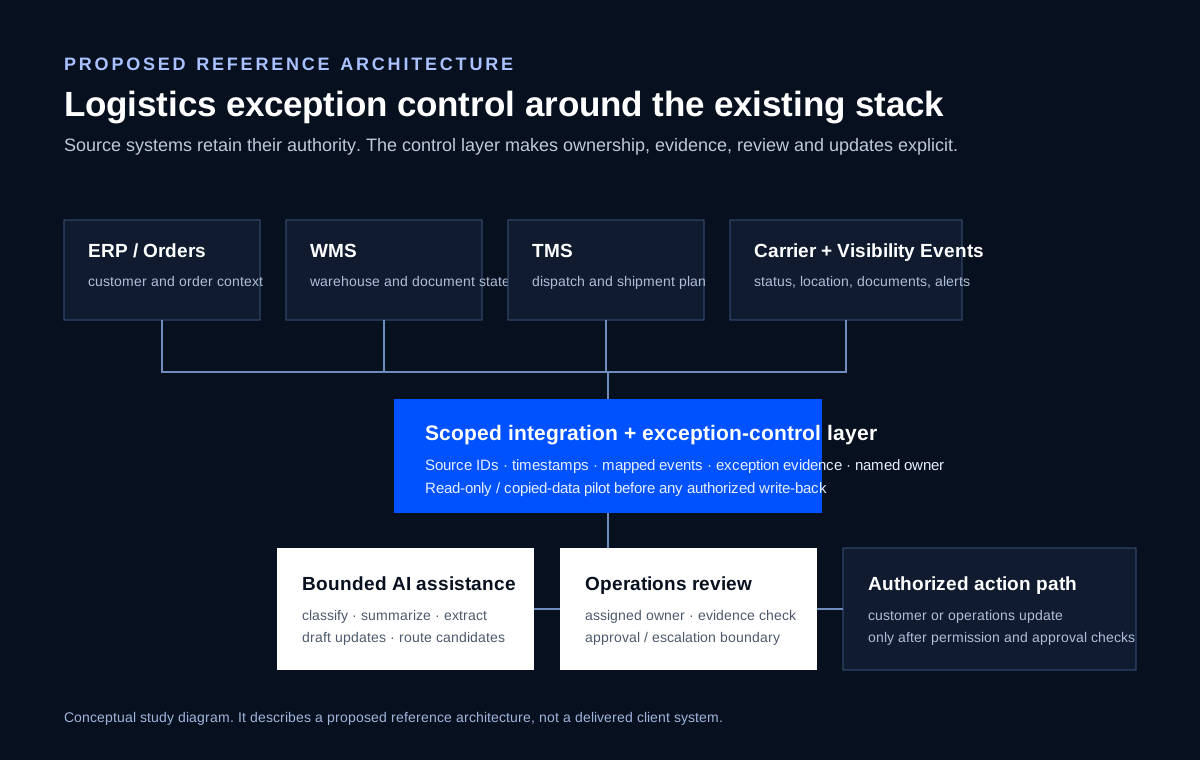
The control layer makes the exception, supporting evidence, named owner, approval boundary and permitted update path visible while preserving each source system's responsibility.
01
ERP, WMS, TMS and approved carrier or visibility feeds continue to own their respective order, warehouse, dispatch and event context.
02
Maps source IDs, timestamps and permitted event or document data for the bounded workflow.
03
Detects configured candidate exceptions, assembles evidence and assigns an accountable next-action owner.
04
Classifies, summarizes, extracts and drafts only within the approved data and task boundary.
05
A dispatcher, operations owner or approver checks evidence and authorizes any consequential update or write-back separately.
AI may classify candidate exceptions, summarize permitted evidence, extract permitted document information, draft operational or customer updates and route work to the right queue. The model assists people with defined tasks; it does not become the operating authority.
AI should not decide which conflicting enterprise system is authoritative, reroute freight, issue a financial credit, change a customer commitment or perform another consequential action without defined authorization and accountable human review.
Use the permissions, APIs and source-data boundaries confirmed for the selected workflow. The exception-control layer should not turn a copied status or a model output into broader authority over a source system.
People retain responsibility for source authority, freight movement, financial commitments, customer commitments and any write-back or notification that requires authorization.
Represent late, missing, conflicting, unassigned and incomplete-work signals as explicit exception states. Preserve source IDs and timestamps, show uncertainty, assign an owner and escalate according to the defined operating process.
Begin by selecting one workflow where status becomes unclear or exceptions go unowned. Define the trigger, source data, owner, due state, customer-impact decision, escalation path and what each connected system continues to own.
Validate data mapping, access permissions and integration behavior with a read-only or copied-data shadow pilot. Test adverse cases before adding authorized notifications, write-back or another workflow.
01
Choose one operational handoff and define triggers, evidence, owner, due state and approval boundary.
02
Confirm source ownership, fields, APIs, permissions, event behavior and document context.
03
Use read-only or copied data for a bounded exception view and queue.
04
Test adverse cases, assignment quality, source conflicts, permission denials and escalation behavior.
05
Add one integration, approved notification or module only when the operating controls are established.
06
Assign support ownership and review data quality, exception patterns, integration health and change impacts.
Dependencies include source authority, field mapping, event quality, permissions, carrier and visibility behavior, document availability, approval rules, field connectivity and operational support ownership.
This is a proposed reference architecture. It does not claim route optimization, real-time tracking, automated dispatch, cost reduction, faster delivery, accuracy, uptime or a completed Vonix Soft customer deployment.
Which source owns each status and customer commitment? What exact event creates an exception? What evidence must accompany it? Who owns the next action? When must a customer update be approved? Which actions are read-only, drafted, queued or separately authorized for write-back?
Start with one operational handoff where visibility exists but ownership does not. Map the source systems, evidence, review boundary and next action before deciding whether configuration, integration or custom software is justified.
FedEx · Attributed logistics-leader survey context on the boundary between visibility and action.

Photo by Compare Fibre on Unsplash
A research-backed study of how enterprises can connect approved knowledge and authorized live business data to AI without treating the model as the authority for access, records or consequential actions.
Next step