Improve the existing process
When it fits: Inputs, ownership, data quality or policy are the primary issues.
Trade-offs: May not resolve a demonstrated scheduling-engine or scenario-analysis gap.
Solution Study
A master schedule allocates time, teachers, rooms, course access and other scarce resources while balancing student requests, requirements, staffing and local priorities. It is an operating model, not just a calendar.
The proposed architecture connects authoritative inputs, governed constraints, an existing or proven scheduling engine, scenario review, exceptions, human approval and controlled SIS write-back. Generative AI is optional assistance around the workflow, not the core scheduling engine.
This is a research-backed Solution Study and proposed reference architecture. It is not a delivered Vonix Soft client case study or a claim about a school or district implementation.
A school or district may need to reconcile course requests, requirements, teacher availability, rooms, periods, sections, class-size targets, program needs, staffing changes and exceptions. A change in one area can create conflicts elsewhere.
Scheduling decisions shape access to courses, teachers, facilities and instructional time. A technically feasible schedule is not automatically the scenario an institution should prefer or approve.
Academic timetabling is a combinatorial optimization problem. Constraint programming, integer programming, heuristics, established SIS scheduling engines and specialist optimizers can all be appropriate mechanisms for searching possible allocations.
The objective function still expresses institutional choices. The school must define mandatory rules, flexible preferences, acceptable trade-offs, review criteria and override authority. The engine searches; the institution decides what better means.
A typical cycle confirms academic structure, collects demand, validates staffing and rooms, defines constraints, generates scenarios, reviews conflicts, adjusts assumptions, obtains approval, commits the selected schedule and handles late changes.
A production design needs an exception layer for missing requests, infeasible constraints, teacher or room changes, enrollments after commit, cancellations, data failures and partial write-back.
PowerSchool PowerScheduler, Infinite Campus Scheduling Board, Timely and Cardonex are vendor-documented examples of existing scheduling functionality. Their published capabilities are product context, not a claim that one product is universally best or that it produces independent outcomes.
A responsible assessment begins with the installed SIS and current process. Better data, clearer ownership and existing configuration may resolve the actual gap without a new platform.
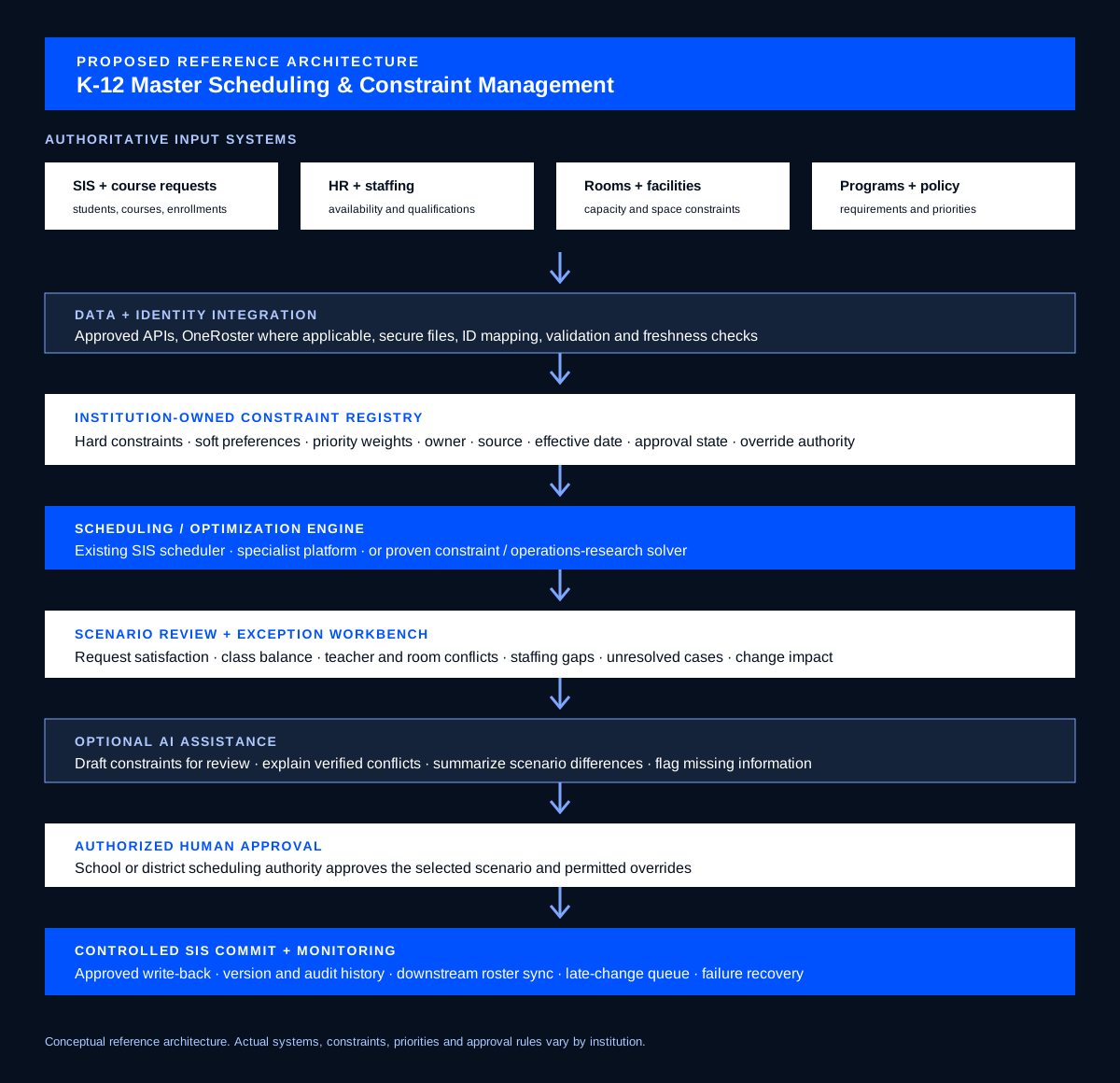
Authoritative SIS, course-request, HR, staffing, facilities and program inputs flow through data and identity integration into an institution-owned constraint registry. An existing SIS scheduler, specialist platform or proven solver generates candidate scenarios for review.
The architecture makes source authority, hard versus soft constraints, ownership, approval state, exceptions and controlled write-back explicit. It is not a claim that Vonix Soft has deployed this design.
When it fits: Inputs, ownership, data quality or policy are the primary issues.
Trade-offs: May not resolve a demonstrated scheduling-engine or scenario-analysis gap.
When it fits: The installed platform meets representative scheduling and review needs.
Trade-offs: Requires disciplined configuration, current inputs and tested constraints.
When it fits: Constraint complexity or repeated scenario work exceeds the current scheduler's verified capabilities.
Trade-offs: Product fit, integration, permissions and operating ownership need evaluation.
When it fits: The core optimizer is adequate but governance, review, approval, exception or change-impact gaps remain.
Trade-offs: Adds integration, support and change-management responsibility.
When it fits: A proven engine can handle search while a focused layer manages institutional process controls.
Trade-offs: Requires explicit ownership boundaries between solver, workflow and source systems.
When it fits: A measured requirement remains unmet after the alternatives are tested.
Trade-offs: Has the highest engineering, optimization, audit and maintenance burden.
Proposed reference architecture
Institution-owned constraints govern a proven scheduling engine. Optional AI assistance supports drafting and explanation before people approve the selected scenario and its controlled SIS write-back.
01
SIS, course requests, staffing, qualifications, rooms, facilities, program requirements and approved local policy retain their source ownership.
02
Approved APIs, OneRoster where applicable, secure files, ID mapping, validation and freshness checks prepare defined inputs.
03
Institution-owned hard constraints, soft preferences, priority weights, sources, effective dates and approval state govern the scheduling run.
04
An existing SIS scheduler, specialist platform or proven operations-research solver searches for feasible scenarios.
05
Authorized users review conflicts, trade-offs, unscheduled requests, staffing or room changes and change impact.
06
Drafting, verified-conflict explanation, scenario summaries and missing-information checks remain reviewable assistance tasks.
07
The accountable school or district role approves the selected version and permitted overrides before controlled SIS write-back and monitoring.
Every material constraint should have a name, description, owner, source, hard or soft type, priority or weight, scope, effective date, review date, approval state, policy rationale and override authority.
Scenario review may consider request satisfaction, unresolved student conflicts, class-size distribution, teacher load, room conflicts, staffing gaps, program access patterns and manual overrides. These are prospective institution-selected measures, not promised Vonix outcomes.
AI may convert administrator-written rules into draft structured constraints for review, explain verified solver conflicts, summarize differences between candidate scenarios, identify incomplete or contradictory inputs, support validated demand analysis and draft communication about approved changes.
The assistance must be grounded in actual source and solver data. AI does not replace the optimization engine, application permissions or the accountable scheduling process.
AI should not define educational priorities, choose which student group loses access, classify institutional policy as mandatory without review, override program rules, approve consequential placements or staffing policy, commit the schedule or bypass permissions.
Hard and soft constraint classification remains institution-owned. Authorized people approve a scenario and permitted overrides before any controlled system write-back.
Role-based access should separate scheduling configuration, student-exception review, program validation, staffing maintenance, technical administration and final academic approval. Technical administration does not automatically create educational decision authority.
The school or district retains responsibility for institutional priorities, hard and soft constraint classification, student placement, staffing policy, scenario selection, overrides and production commit approval.
Represent infeasible constraint sets, missing requests, staffing or room changes, course cancellation, late enrollment, source-data issues, solver failure, write-back failure and permission mismatch as explicit states with a named owner, source context, recovery action and audit trail.
Begin with discovery: installed systems, scheduling process, course requests, staffing, facilities, constraints, scenario review, approvals, exceptions and write-back. Then improve data and constraint readiness before replacing technology.
Test the existing scheduler and, if necessary, specialist products against representative cases. Build integration, governance, scenario-review, exception or controlled write-back components only where a verified gap remains. Use a controlled pilot before production operation.
01
Map installed systems, current workflow, source ownership, constraints, scenario review, exceptions and approval roles.
02
Validate requests, staffing, rooms, hard constraints, soft preferences, owners, override rules and review measures.
03
Test the installed scheduler against representative institutional cases before replacement.
04
Compare products or build only verified integration, governance, scenario-review or exception gaps.
05
Use approved test or pilot data to validate constraints, permissions, scenario differences, write-back and recovery.
06
Monitor conflicts, overrides, late changes, freshness, integrations, access, version history and commit state.
Bad requests, stale staffing records, incorrect room data, vendor limitations, API outages and unclear policy can produce misleading results. Optimization does not itself make a schedule fair, and vendor documentation does not establish independent performance, savings or outcomes.
OneRoster can support exchange of people, courses, classes, organizations, terms and enrollments, but it is not a complete scheduling standard. Student and workforce data require institution-specific access, privacy, contractual and legal review. This study does not claim FERPA compliance.
The stronger strategy is to define priorities, clean inputs, govern constraints, evaluate existing scheduling engines, compare scenarios, route exceptions, require authorized approval and commit through controlled system boundaries. The software can optimize the schedule. It cannot decide what the school should optimize for.
Stanford SCALE Initiative / National Student Support Accelerator · March 1, 2025 · Educational framing for master scheduling as critical resource allocation; includes a vendor-affiliation caveat in the supplied editorial source.
Center for Public Research and Leadership, Columbia Law School · January 1, 2021 · Master-scheduling context and access-to-opportunity framing.
Expert Systems with Applications · January 1, 2021 · Combinatorial optimization context.
Annenberg Institute at Brown University · July 1, 2026 · 2026 working-paper context with limitations preserved in the editorial source.
AAAI · January 1, 2025 · Student-abstract modeling context, not universal outcome evidence.
1EdTech · People, courses, classes, organizations, terms and enrollments interoperability context.
U.S. Department of Education · Student-record and personally identifiable information context, not a compliance certification.
PowerSchool · Vendor-attributed existing scheduling capability context.
PowerSchool · Vendor-attributed build, load and commit workflow context.
Infinite Campus · Vendor-attributed conflict-management context.
Infinite Campus · Vendor-attributed scheduling-process context.
Timely · Vendor-attributed specialist scheduling-platform context.
Timely · Vendor context only.
Cardonex · Vendor-attributed scheduling and integration context.
Cardonex · Vendor-attributed scheduling context.

Photo by Martin Woortman on Unsplash
K-12 schools can have capable SIS, LMS, attendance, assessment and family communication tools yet still face fragmented workflows as one student journey crosses platforms. This study examines how standards, APIs, identity and role mapping, workflow orchestration and controlled AI assistance can connect them without creating a second source of truth.

Photo by engin akyurt on Unsplash
A research-backed study of how K-12 schools can connect attendance, learning, assessment and support workflows across existing systems while preserving source ownership, permissions and human decision-making.
Next step