Vonix Soft Logo

Solution Study

K-12 Student Support Coordination

Attendance, learning activity, assessment context, referrals, support history and family communication can sit in different systems even when each system is doing its own job correctly. The operational challenge is coordinating an appropriate next step across them.

This proposed reference architecture connects approved student-support signals through integration and data-quality controls, identity and permissions, case ownership, workflow state, optional bounded AI assistance and authorized human decisions. It preserves the SIS, LMS, assessment, communication and approved support systems as the owners of their records.

This is a research-backed Solution Study and proposed reference architecture. It is not a delivered Vonix Soft client case study or a claim about a school or district implementation.

K-12 educationStudent support coordinationPublished October 8, 2026By Mirza Abdul Rehman, AI Engineer
01

The operational problem

A student-support case can span attendance in the SIS, learning activity in the LMS, assessment information, teacher concerns, intervention history and family-contact status. The school may have the information without having one coordinated workflow for the people responsible for support.

A useful workflow helps authorized people locate relevant context, confirm source authority and access, assign ownership, identify the next follow-up, record what happened and return to the case later. It should not reduce a student to a collection of scores or signals.

02

What the research supports

Ed-Fi describes attendance, grades and test scores as information that can be trapped in separate platforms. Its data standard and LMS Toolkit provide interoperability context for combining approved learning, administrative and assessment information around defined educator workflows.

U.S. Department of Education guidance describes attendance and engagement as shaped by multiple, interconnected factors. An attendance signal can justify attention, but it should not automatically become a conclusion about an individual student.

03

Current state and system context

A teacher may see missed work in the LMS, an attendance team may see repeated absence in the SIS, and a counselor or MTSS team may already have approved support context elsewhere. A coordination workflow needs defined source ownership, freshness, access, case ownership, review points and failure paths.

A connected view does not mean universal access. Every district must define which system is authoritative for a field, which roles can see it, what can be summarized or cached, and when a conflict must be routed to an authorized person.

04

Existing solution landscape

Dedicated MTSS and student-support products already provide combinations of academic, attendance, behavior, referral, intervention, progress-monitoring, case-note and family-collaboration workflows. Panorama Education and Branching Minds are current market examples, not Vonix partners or endorsements.

The decision should begin by testing whether a dedicated product, existing configuration, supported integration or a narrow custom layer best fits the real operating gap. A new dashboard is not automatically the right answer.

06

Proposed reference architecture

The proposed K-12 Student Support Coordination Layer receives only approved, workflow-relevant information from existing SIS, LMS, attendance, assessment, support and family-communication systems. Integration and data-quality controls apply identity matching, field mapping, freshness checks, source-of-record rules and sync-failure handling before a role-based coordination workflow is available.

The coordination layer can represent authorized context, referral intake, a named case owner, status, assigned follow-up, support references, scoped notes, family-contact status, review checkpoints and an exception queue. It is not a replacement SIS, LMS, assessment platform or MTSS platform.
05

Options and trade-offs

Buy a dedicated MTSS or student-support platform

When it fits: The district needs a consolidated commercial workflow and the current stack lacks mature intervention planning, referrals, case ownership or progress monitoring.

Trade-offs: Migration, product fit, cost, adoption and integration requirements need validation.

Improve the current platform

When it fits: The needed workflow, API or permission capability already exists but is poorly configured or disconnected.

Trade-offs: Configuration may not resolve material cross-system gaps.

Integrate the current stack

When it fits: Core SIS, LMS, assessment, communication and support systems should remain while their workflow coordination improves.

Trade-offs: Requires integration ownership, source rules, permissions and data-quality controls.

Build a scoped coordination layer

When it fits: A tested workflow remains unsupported after buy and improvement options are assessed.

Trade-offs: Creates product, maintenance, privacy-review, integration and operating obligations.

07

Proposed reference architecture

Reference architecture

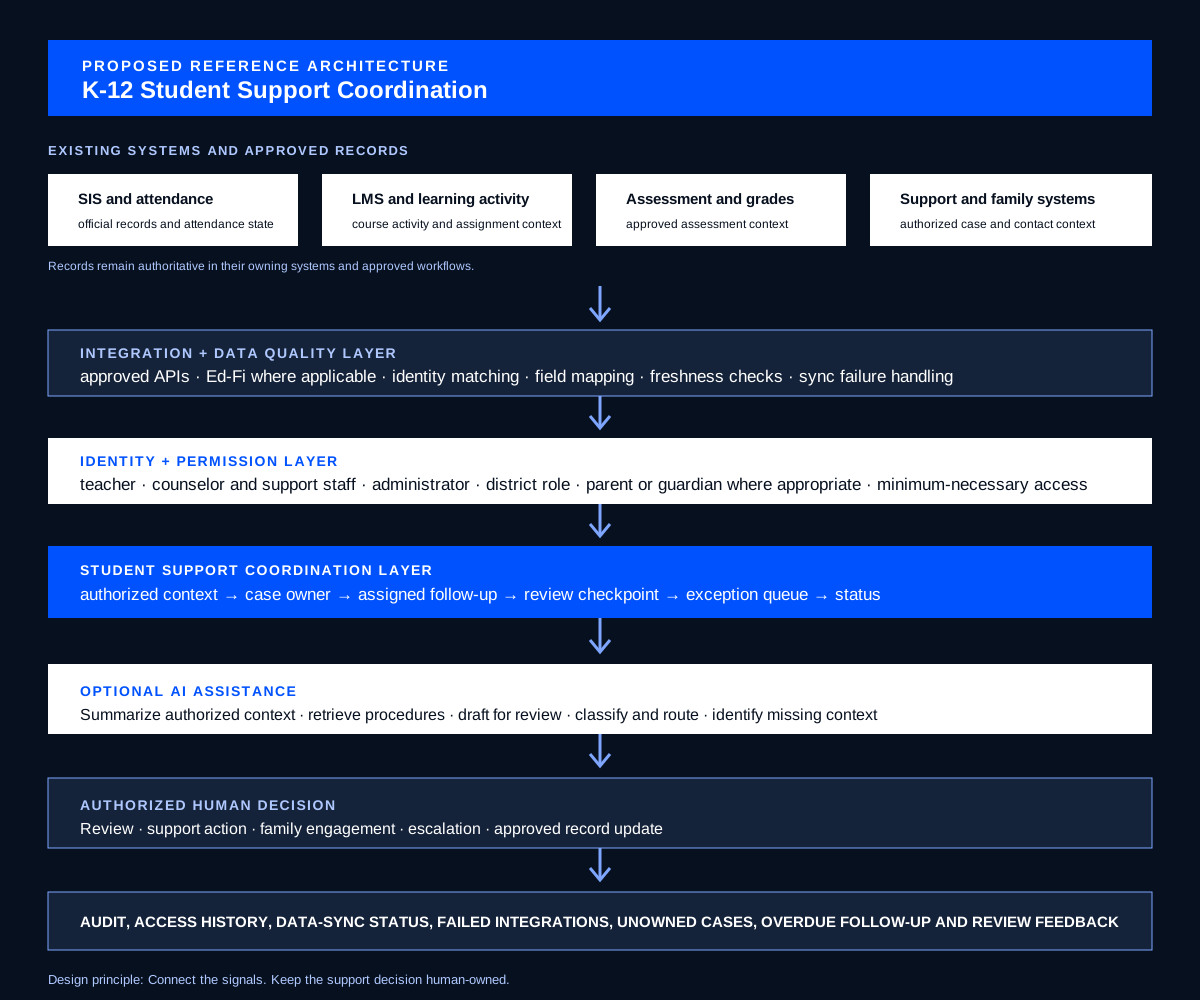
Information movement and decision authority remain distinct. Existing systems retain their records while authorized staff retain responsibility for support decisions and consequential actions.

Proposed K-12 student-support coordination architecture linking approved school systems through integration, permissions, a coordination workflow, optional AI assistance and authorized human decisions.

01

Existing systems and approved records

SIS, attendance, LMS, assessment, support and family-communication systems retain their respective records and approved workflows.

02

Integration and data quality

Approved APIs, Ed-Fi where applicable, identity matching, field mapping, freshness checks and sync-failure handling provide defined workflow context.

03

Identity and permissions

Role-based and minimum-necessary access controls determine who may retrieve or act on which information.

04

Student-support coordination

Authorized context, case owner, follow-up, status, review checkpoints and exception handling make the next operational step visible.

05

Optional AI assistance

Summarization, approved retrieval, drafting, classification, routing and missing-context checks remain reviewable assistance tasks.

06

Authorized human decision

Teachers, counselors and authorized staff retain responsibility for support action, escalation and any approved record update.

07

Where AI can assist

AI may summarize already-authorized context, retrieve approved procedures, draft a communication for staff review, classify or route a request, identify missing context and prepare a case brief. Each task remains reviewable against approved sources.

The role is narrow assistance inside a controlled workflow. A user must be able to inspect source information, correct or ignore an AI output, and continue without AI when appropriate.

Authorized-context summarizationApproved-procedure retrievalCommunication drafting for reviewRequest classificationWorkflow routingMissing-context identificationCase-brief preparation
08

Where AI should not decide

AI should not independently label a student as at risk as a consequential decision, diagnose a student, choose an intervention, make disciplinary or safeguarding decisions, assign grades, infer sensitive facts, bypass permissions or contact families on sensitive matters without the required review.

Preferred operating model: signals, then an authorized staff view, context gathering, human review and support action. The model does not become the authority over a student's support path.

Permissions

Role-based, minimum-necessary access and institution-specific controls determine which information each teacher, counselor, support staff member, administrator, district role or parent or guardian may see. A unified screen does not create universal access.

Human review

Authorized people and formal institutional workflows retain responsibility for student-support decisions, interventions, discipline, safeguarding, grades, sensitive-family communication and other consequential actions.

Exceptions

Represent stale data, student-identity mismatch, conflicting records, failed synchronization, incorrect AI summaries, unowned cases, overdue follow-up and unauthorized requests as explicit states with a named owner, source context, status and recovery or escalation path.

09

A practical first release

Begin with one bounded support workflow rather than a district-wide platform replacement. One example is attendance plus missing assignments plus a teacher referral flowing into a role-based student-support review queue.

A first release can connect official attendance, selected LMS assignment status and structured referral intake; assign an authorized case owner; show source timestamps and context; record follow-up status; optionally draft a family communication for review; and log actions and exceptions.

  1. 01

    Workflow discovery

    Map one support process from first signal to follow-up, including roles, systems, data sources, manual handoffs, permissions, exceptions and ownership.

  2. 02

    System and data assessment

    Review available APIs, Ed-Fi compatibility where applicable, data quality, identity matching, freshness, integration constraints and current-platform capabilities.

  3. 03

    Buy, improve or integrate decision

    Test existing products and current-platform capabilities before approving custom development.

  4. 04

    First workflow release

    Connect only the data and roles required for the chosen workflow, with case ownership, source timestamps, exception handling and audit.

  5. 05

    Evaluation and controlled expansion

    Evaluate technical quality, workflow completion, adoption, correction rates and exceptions before adding additional workflows.

10

Risks and limitations

Integration cannot correct inaccurate source records, incorrect identity matches, overly broad access, notification fatigue, simplistic early-warning logic, vendor limitations or local policy differences. Generated summaries can omit context, misstate information or overstate certainty.

This study does not certify FERPA compliance or any legal, privacy or security requirement. It does not claim a delivered Vonix Soft K-12 implementation, student outcomes, ROI, efficiency improvement, partnership, certification or product availability in a particular district.

11

Questions before implementation

What exact support workflow is being improved? Which roles participate? Which systems hold the relevant information? Which system is authoritative for each field? Which information must be live? Who can view each type of information? Who creates and owns a case? What happens when systems conflict or an integration fails? Is AI necessary for a specific task, and who reviews consequential outputs?

12

Conclusion

The student-support problem is not simply that schools have too many systems. It is whether authorized people can work from the right context and coordinate a clear next step. Existing products and interoperability standards should be assessed first. Where a real gap remains, a scoped coordination layer can connect approved signals while keeping the support decision human-owned.

Sources

  1. 01What is the Ed-Fi Data Standard?

    Ed-Fi Alliance · Interoperability context for education information that can be separated across platforms.

  2. 02Ed-Fi LMS Toolkit

    Ed-Fi Alliance · LMS, SIS and assessment information context for defined educator workflows.

  3. 03Supporting Student Attendance and Engagement

    U.S. Department of Education · Attendance and engagement context with multiple interconnected drivers.

  4. 04SEAC Learning Series Activities

    U.S. Department of Education · Student attendance and engagement resource context.

  5. 05Chronic Absenteeism

    Institute of Education Sciences · Evidence-based chronic-absenteeism context in the supplied study.

  6. 06Data Standard v5

    Ed-Fi Alliance · Additional Ed-Fi data-standard reference from the supplied study.

  7. 07MTSS Software Platform

    Panorama Education · Vendor-attributed example of a current student-support platform category.

  8. 08Student Success Product Tour

    Panorama Education · Vendor-attributed student-support product context.

  9. 09MTSS Platform

    Branching Minds · Vendor-attributed MTSS platform context.

  10. 10Legitimate Educational Interest FAQ

    U.S. Department of Education Student Privacy Policy Office · Role-based educational-record access context, not a compliance certification.

  11. 11Online Tools and FERPA FAQ

    U.S. Department of Education Student Privacy Policy Office · Institution-specific privacy review boundary.

Related

Related resources

Solution Study

Connecting Students, Teachers, Families, and School Systems Without Replacing the Stack

K-12 schools can have capable SIS, LMS, attendance, assessment and family communication tools yet still face fragmented workflows as one student journey crosses platforms. This study examines how standards, APIs, identity and role mapping, workflow orchestration and controlled AI assistance can connect them without creating a second source of truth.

Research-backed studyRead study
Layered white panels rising in even rows against a pale sky.

Photo by Tato Lopez on Unsplash

Solution Study

What Should AI Trust in Higher Education?

Higher-education AI can retrieve policies, answer questions, and assist with student-service work, but reliable operation depends on knowing which source is authoritative, what data must be read live, who may see it, and which actions require institutional approval.

Research-backed studyRead study
AI Solutions and AutomationsCustom Software DevelopmentCloud and DevOpsBusiness SystemsIntegration SolutionsAI and Automation Solutions

Next step

Discuss the system, ownership and decision boundary behind the problem.

Discuss your system architecture